

Showing posts with label Science. Show all posts

Thursday, July 15, 2010

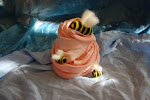
Summer Bees Needle Felting Tutorial

Bees

Buzzing bees, buzzing bees,

Buzzing and bumbling from flower to flower,

Suckling sweet nectar out of the bloom,

To fill with gold your honeycomb bower.

~Paul King


This tutorial goes out to Honey from Mondorfment for her wonderful Sunshine Award nomination :D I haven't done a simple craft tutorial in far too long, so here's a fun and easy one for summer!

Supplies:
- needle felting needle
- needle felting pad or a sponge
- three colors of wool roving (black, yellow, white/cream)
- optional: string or yarn, sewing needle, scissors, twig

Step 1: Take the black roving and roll it tightly with your fingers, securing it with the needle felting needle by jabbing it in several times. The barbs on the needle with help the wool grab onto the other fibers, thereby binding it into your desired shape.


Step 2: Once you have the size/shape of your bee, take a little thin bit of the yellow wool roving and wind it onto the bee in stripes. Needle felt into place. The needle does not need to go *all the way through*, as the barbs are on the very tip. That will also push some of the wool through to the other side and can discolor your project a bit.


Another fun and easy needle felting tool which I highly recommend is the Clover needle felting tool. It has five needles and a safety guard, which makes it a nice tool for younger needle felters. It comes with fine pointed needles, but you can also purchase thicker needles, as well. Shop around for better prices - often found in your local crafting shop!

Step 3: Take your white or cream colored wool and round the edges with your needles, making it into the shape of little wings.


Step 4: Needle felt the wings on.


Voila!


If you have younger children, you can make the bees bigger to make them safer and easier to handle.

***Remember that the wool can be a choking hazard, so please don't give these to little ones under 3 or even those who still put things into their mouths***

Here is a larger bee I made for a 3+ little one from my shop.


Now for a fun *optional* project using your lovely needle felted bees...


Have your child find some nice sticks or twigs on a nature walk. You can sand and polish for fun, if you'd like. These ones are in their natural state...

Thread a sewing needle with some thread or yarn and attach to the bees.

Tip: I like to come in through the top of the bee, hidden by the wings, and then pull it through to the bottom, and come back up again through the wings to make it extra secure. If you just come up through the bottom, your knot might not be tight enough to hold and your bee will literally go flying off the string (probably to the delight of your child - lol)!


These are wonderful as puppets, for plays, free play, nature/seasonal tables, and gifts. The simple shape is a wonderful place to start for beginning needle felters :D

This would also be amazing to add to Grade 3 curriculum when studying the bees!


Hope you enjoy!

Friday, May 28, 2010

Friday Book Review: Around the Oak


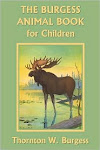
This week, I wanted to review this gorgeous book by the famed Gerda Muller, called "Around the Oak". Muller is the author of the gorgeous pictorial seasonal series found here.

"Around the Oak" is a story about two cousins (Caroline and Ben) who go to visit their cousin, Nick, who lives in the middle of a lush forest. His father, a forest ranger, and Aunt Vera, inspire the children to venture into the forest to learn all about life there. The story takes place over four seasons and centers around a very old, special oak tree.

It begins in the Fall (making this book a wonderful seasonal read each school year)...


The children hike to the giant oak, climb the tree and discover wildlife there. Realizing this, they decide to make a shelter on the ground to observe the wildlife unseen.


They notice the changes that take place day to day and learn to pick chanterelles. They plant trees and immerse themselves in the realm of nature, learning through observation and direct participation.

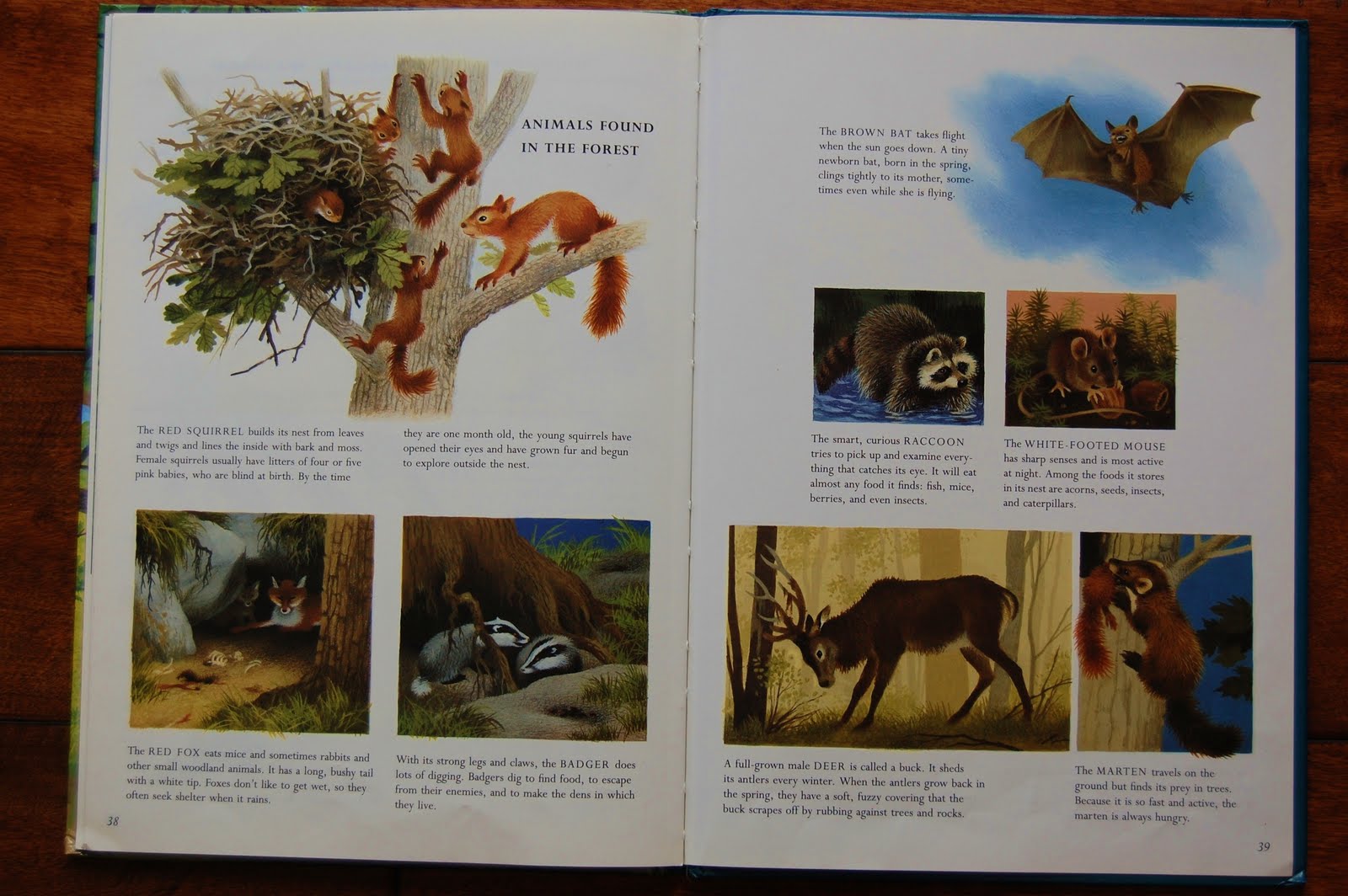
The children return in Winter and cross country ski to visit their beloved Oak. They encounter some screech owls who are nesting in the tree, as well as observe a marten chasing a squirrel.

The children find Uncle Hank, the forest ranger, with a tree doctor, analyzing the trees and identifying the sick ones that will be cut down. They learn that pollution makes trees sick through acid rain.


In the Spring, the cousins return on their spring vacation and are overwhelmed by the budding flowers and trees. They note the acorns and chestnuts (fruits) that develop from flowers. They take an evening walk with Uncle Hank in search of wildlife and observe several in their natural habitat. They learn to respect nature and keep a respectful distance from the wild animals. At the Oak, they spot badger tracks and sit very still, being rewarded by a couple of animals who come to the watering hole to drink (a fox and a family of deer).


Ben comes home last and showcases his nature collection, complete with classifications.


In late summer, the children return for another visit and notice the early change of some of the leaves. They discuss the cycle of life of the oak tree.


They decide to give their Oak Tree a 300 year old b-day party!


After this, the story pretty much ends and Muller provides various tidbits of information about how sunlight helps trees grow, gaging the age of a tree, tiny insects, birds, leaves...

plants...


and animals...


The story ends on the birthday page with Caroline singing softly to the tree...

"Happy birthday, dear oak tree...
I hope you live another hundred
years."

This book is currently out of print, but might be found in your local library or can be purchased used. After checking it out a couple of years ago, I decided it was one we wanted on our shelves and found a nice used copy. I like to read it to the girls seasonally. As a reviewer mentioned, the story alone would probably not hold as much interest for the children, but is actually used as a vehicle to take children along the journey of learning about nature from a book - certainly not as profound or everlasting as learning directly from nature, but a nice place to start or revisit after those nature hikes. Since we're wrapping up our combined lower case letters/nature studies block II, I thought it befitting to review this book today!

The illustrations are gorgeous, as seen above and very captivating! This is a nice book to go through for inspiration and for reinforcing knowledge most of your little ones probably already know :D though their hands on exploration!

Enjoy!

Wednesday, May 19, 2010

Language Arts Block III: Lower Case Letters & Nature Stories


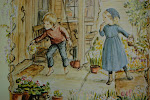
"Then the door of the cottage opened and to Lisa's surprise, all the house plants started cautiously coming down the steps, the two Miss Pelargoniums first, then plump little Mrs Myrtle, followed by grand Lady Fuchsia."


Lower case letters are introduced in either Grade 1 or Grade 2 in waldorf schools. It largely depends on the teacher and what was covered in the year/the progress of the students. Originally, I hadn't planned on "introducing" lower case letters until Sept of Grade 2, but to my amazement, the girls have picked them up organically through all the books we've read and sentences we have copied in our Main Lesson Books. So instead of doing our last LA Block on fairytales, I decided to take a page from Eric Fairman's Grade 1 book and combine lower case letters with a second Environmental Studies block using Nature Stories. We have had many, many fairytales and this is a wonderful opportunity to balance them out with more Nature Stories.

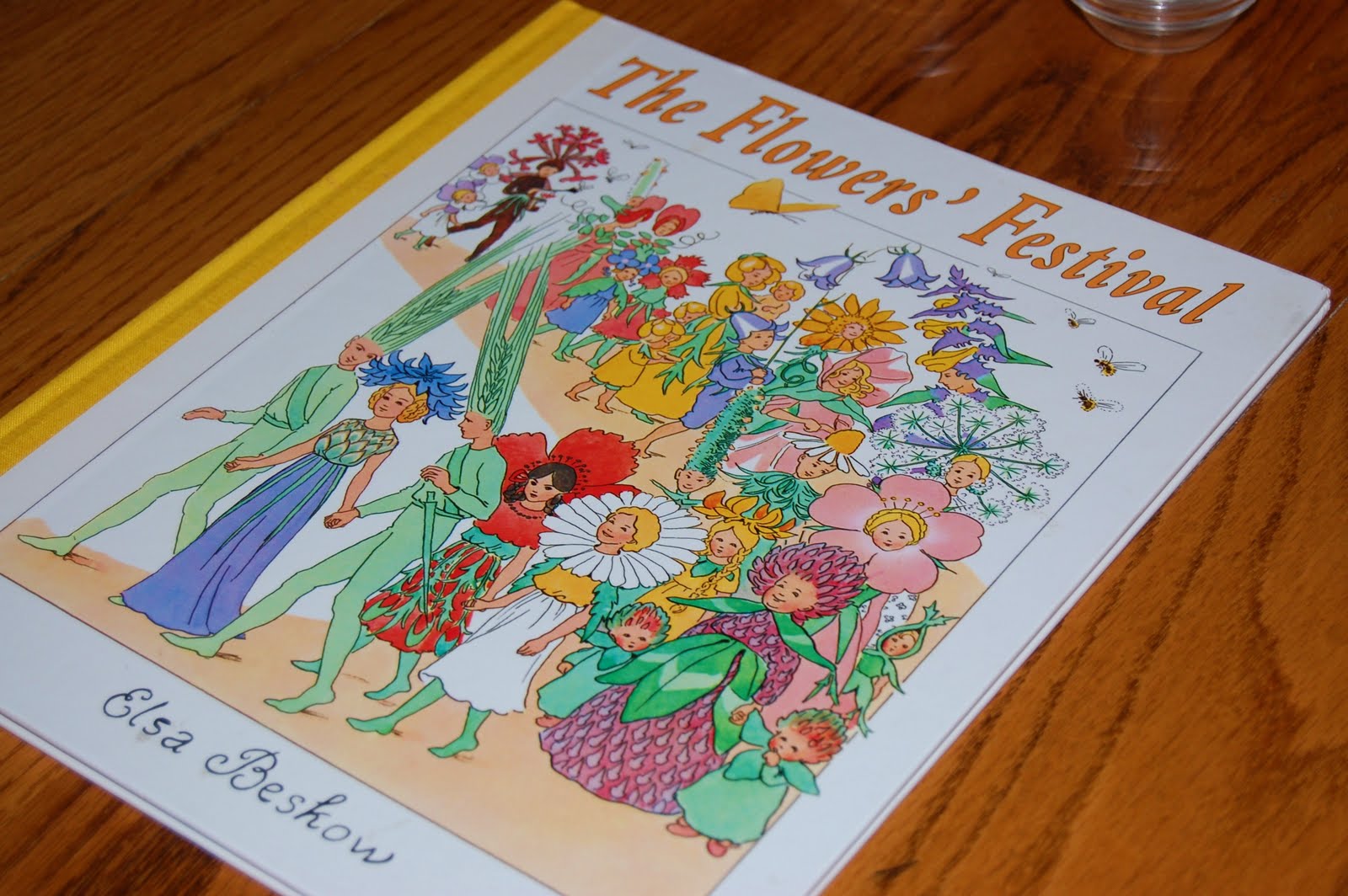
We decided to start with the lovely Elsa Beskow book, "The Flowers' Festival", in honor of spring and all the flowering plants. The book will be reviewed on Friday and is actually intended for Midsummer, so I thought it would be nice to review it early so that those who wish to get it from the library or bookstore have ample time :D

After snuggling on the couch to read the book together, we got out our lovely smelling modeling beeswax. When I visited the Steiner College Bookstore, I purchased some individual blocks by Stockmar (I think) and was impressed by how much softer they are than the Artimis brand by Mercurius. I would recommend seeking Stockmar out instead as little children get impatient waiting for them to soften. We stuck them under our arm pits and in no time we were ready and lovely flowers began to appear.

My expert modeler is Elena. She LOVES to work with her hands, always has and spends hours with Model Magic or any kind of modeling clay she can get her hands on. These are some of her flowers...


Tulip...


Two Tulips together...


A yellow rose...


Both girls engrossed in modeling...


And this was our final scene. Charley made the three multi-colored flowers on the left and Elena made the rest of them...we placed them on our seasonal table.

We continued with our next activity...


Wet-on-Wet Watercolor Painting...


Charley has a fascination with Mother Mary and has painted her on more than one occasion.


Our finished flower inspired paintings...


And little Jacky taking a snooze under his fleece baby blanket...


Still in our pajamas the next day - ah a benefit of homeschooling...

We decided to finish our PeeWee drawings for our seasonal book.


And today, we drew a spring picture from "The Flowers' Festival" in our special seasonal book that will be bound at the end of the summer.


I have chosen several stories to tell over the next couple of weeks and following Marsha Johnson's lead, I will introduce the lower case letters over the course of three days. Since the girls are already very comfortable and familiar with them, I didn't find it necessary to work as slowly as I did with the upper case letters and vowels.

Kristie Burns of Earthschooling has a lovely lower case letter alphabet book that her daughter illustrated, along the vein of the Waldorf Alphabet Book that we will also review together for fun! It is available here. I'll be using it later in this block and will talk more about it then :D

Blessings to you all!